According to a report by Yahoo News, on April 14, a handful of Bremen High School District 228 board members sat through a committee presentation that should have been routine and turned out not to be. Oak Forest officials were asking the district to approve a tax increment financing extension thirteen years before that TIF is scheduled to expire. A few board members called the timing unusual. They had more questions. They did not vote.
That five-minute disagreement over paperwork is the most useful thing a buyer or seller can know about Oak Forest right now, because it explains why the town's median price and its actual value don't line up the way the portals suggest.
What the City Was Actually Asking For
The extension request wasn't abstract. Paul Ruane, Oak Forest's assistant director of community and economic development, told the board it was tied to a specific deal: developer Deshe Real Estate wants to build two commercial buildings and two 60-unit apartment buildings on the 5100 block of West 159th Street, at the northwest corner of 159th and Le Claire Avenue. The site has sat vacant since a mobile home park closed there more than twenty years ago. Deshe told the city it can't finance the project without TIF dollars covering roughly $8 million in eligible costs.
The TIF district in question runs along West 159th Street between Laramie Avenue and the Metra tracks, next door to Oak Forest's TIF 3, which follows Cicero Avenue to the station. Under Illinois law, a TIF can run for up to 23 years unless a municipality extends it. Oak Forest wants more runway to keep courting developers in that corridor, and Ruane told the board that if the city finishes its projects early, it's open to ending the TIF ahead of schedule too. The school board hadn't signed off as of that April meeting, which means the two 60-unit buildings Deshe wants to build are not yet a sure thing.
The Corridor Already Has a Track Record
This isn't a hypothetical redevelopment pitch. The city has already delivered on a version of it once, a few blocks away:
- A 75-unit, 15-rowhome mixed-use project on West 157th Street, built by a partnership that included Deshe and known as 157th LLC, is complete and sits as an anchor for further development along the nearby Cicero Avenue corridor. Economic Development Director Ed Cage called it a project that "encapsulates exactly the type of new development we desire in Oak Forest, a mixture of commercial and residential living options."
- Waverly Creek, on the former Ace Hardware site at 15541 S. Cicero Avenue, replaced a building that had been vacant since it closed in 2009. It pairs 29 townhomes with roughly 5,000 square feet of commercial space, two-thirds of which is already leased to Midwest Express Clinic.
- EM8 Properties, whose managers include Etamar Deshe, the same principal behind Deshe Real Estate, has since acquired the apartment buildings next door at 15701 Lamon Avenue and 4823 W. 157th Street and is renovating them into 20 studio and 20 one-bedroom units as part of the same "One Fifty Seven Oak Forest" community.
In other words, the same small group of people and entities has been building a specific product along this corridor for a few years now: newer construction, walkable to the Metra station, priced and sized differently than what's on the rest of the town's inventory. The pending 60-unit buildings on West 159th would be a third phase of the same pattern, if the school board eventually agrees to it.
What This Has to Do With Your Median Price
Here's where it connects to anyone actually shopping this stretch of the southwest suburbs.
As of August 2026, Oak Forest homes were listing at a median of roughly $324,000, working out to about $198 a square foot. Over the three months ending May 2026, Orland Park's median sale price ran closer to $385,000, or about $200 a square foot, up more than 6% year over year. Tinley Park's average home value sat around $329,000 as of the end of April 2026, putting it above Oak Forest and below Orland Park on a straight dollar basis.
| Suburb | Recent price point | Price per square foot |
|---|---|---|
| Oak Forest | ~$324,000 median list (Aug 2026) | ~$198/sq ft |
| Tinley Park | ~$329,000 average value (Apr 2026) | not separately available in this window |
| Orland Park | ~$385,000 median sale, 3 mo. ending May 2026 | ~$200/sq ft |
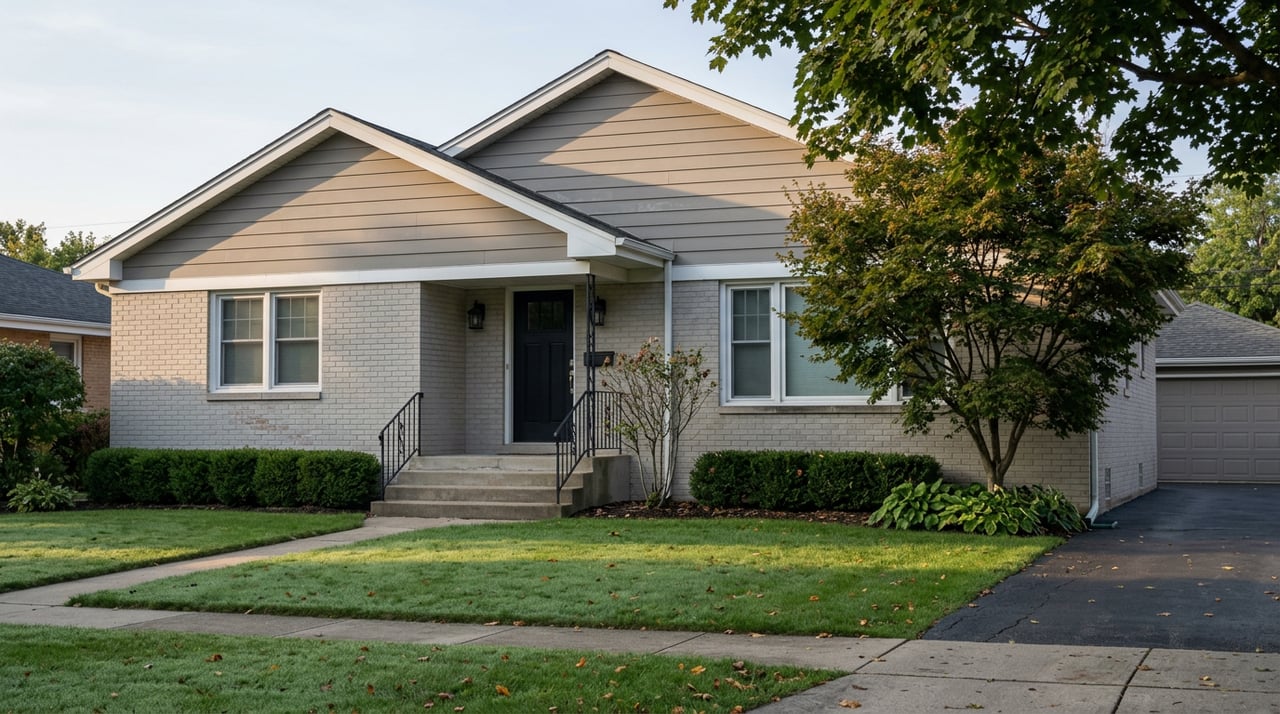
Look at that last column. Oak Forest and Orland Park are charging almost the same amount per square foot, even though Orland Park's median price sits more than $60,000 higher. That gap isn't really a value gap. It's a size and age gap. More than half of Oak Forest's housing stock dates to the 1970s, 80s, and early 90s, another third was built between 1940 and 1969, and only about 8% has gone up since 2000. That's a town built almost entirely on smaller-footprint ranches and split-levels, with very little new construction outside the corridor. You're not paying less per square foot in Oak Forest. You're buying fewer square feet.
That's the part a median-price comparison hides. "Oak Forest is cheaper than Orland Park" is technically true and functionally misleading, because the dollar-per-square-foot cost of the two towns is nearly identical. The discount is a size discount, not a bargain.
Two Products Under the Same ZIP Code
This is also why the corridor development matters more than a typical redevelopment story. The rowhomes and townhomes going up along this corridor, and whatever eventually gets built on West 159th if the TIF extension clears, aren't just new. They're a structurally different product than the older ranch and split-level stock that makes up most of the town's inventory. Newer construction, built at higher density, sized and finished for a buyer who isn't necessarily shopping for a quarter-acre lot.
That means "Oak Forest" on a listing search currently spans two different markets sitting on top of each other. One is the legacy stock: older, smaller, priced to reflect its age and square footage, which is most of what's actually for sale today. The other is the TIF corridor product: newer, denser, priced closer to what you'd pay per square foot in a town like Orland Park, but concentrated in a few blocks around the Metra station and still expanding.
If you're cross-shopping Oak Forest against Tinley Park or Orland Park using median price alone, you need to know which of those two products you're actually pricing. A three-bedroom ranch from 1965 and a new rowhome at Waverly Creek can carry a similar list price and still represent completely different bets on square footage, maintenance, and resale five years from now.
What This Means If You're Timing a Purchase
The practical takeaway isn't that one town is better than another. It's that the corridor redevelopment is still mid-build, and its next phase is sitting in front of a school board that hasn't approved the financing yet. If you want the newer product specifically, today's inventory near 159th and Cicero is still thin, and the next wave depends on a vote that hadn't happened as of this spring. If you're comparing Oak Forest's overall median to a neighboring suburb's, you're mostly comparing older housing stock, not the corridor's new construction, and the per-square-foot numbers above are the more honest yardstick than the median alone.
A Few Questions Worth Asking Before You Compare Towns
Is Oak Forest actually cheaper than Tinley Park or Orland Park? On a per-square-foot basis, it's closer to Orland Park than the median prices suggest. The lower overall price mostly reflects smaller, older homes, not a lower cost per square foot.
What's actually happening at 159th and Cicero? A multi-year, TIF-financed redevelopment around the Metra station has already delivered a 75-unit mixed-use project and the 29-townhome Waverly Creek development. A next phase, two 60-unit apartment buildings on West 159th, is still waiting on a school district vote on extending the TIF.
Should I wait for new construction near the Metra station? That depends on what you're looking for. The corridor product is newer and denser but limited in supply and tied to a financing decision that hasn't been finalized. If you need a place now, most of what's actually listed in Oak Forest today is the older housing stock, priced accordingly.
If you're trying to figure out what a specific Oak Forest address is actually worth, given its age, its square footage, and its distance from that corridor, that's not a spreadsheet question. It's a walk-the-block question. The Niki Rocco Group works this stretch of the southwest suburbs block by block, and a free home valuation is the fastest way to see where your property actually sits in this math, not just where the median puts it.
This article is general information, not legal, tax or financial advice. Consult a qualified professional about your situation.